
In a previous article, we’ve talked about permalinks, what they are, what their benefits are, and we also saw some examples. In this article, we will talk about permalink structures in WordPress, what do they mean and how you can work with them.
If you run a website on WordPress, if you go to Dashboard, Settings, Permalink, we will something similar to the below screenshot:
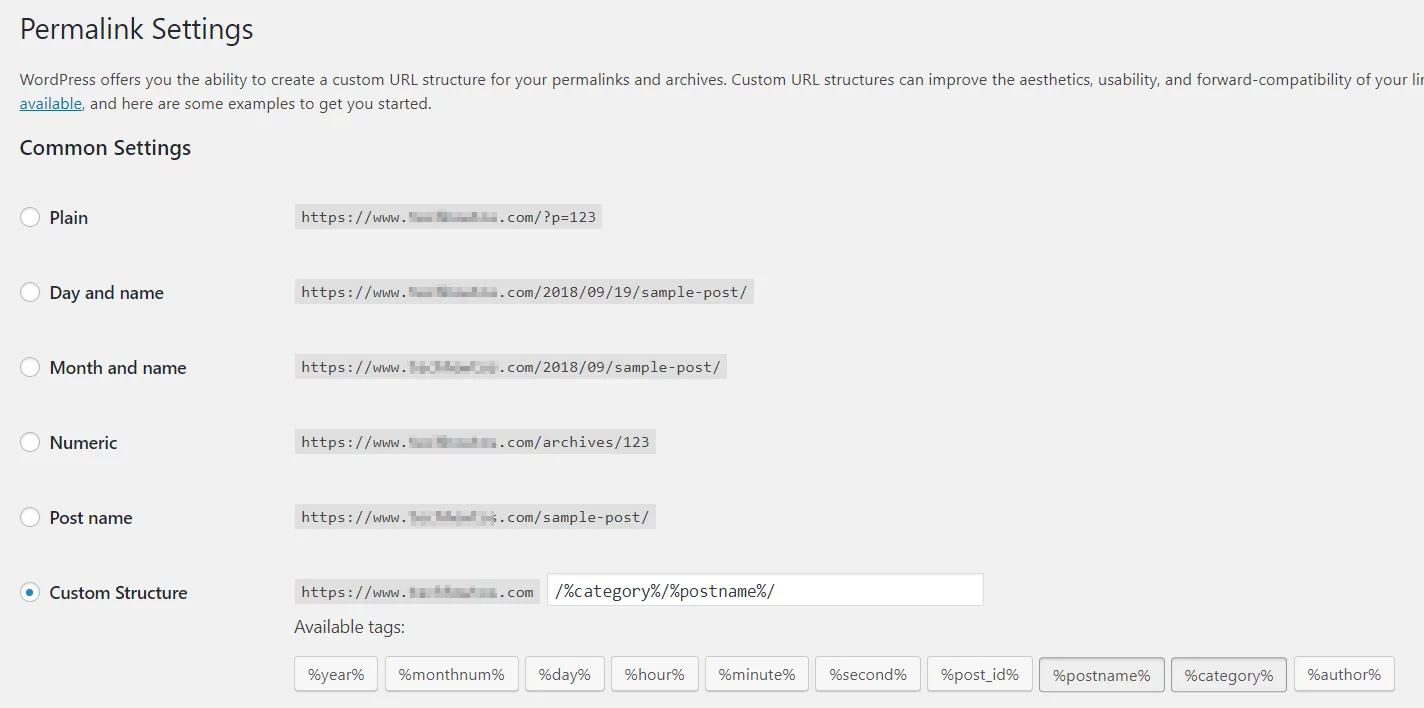
As you can see in the above screenshot, WordPress offers you 5 predefined permalink types and a custom one, which basically allows you to set virtually any permalink type you like.
Let’s further discuss each permalink type option along with providing an example of a URL for each one of them:
- Plain:
- All your blog post URLs will follow the URL template: https://www.[your-domain-name].com/p-123
- Day and name:
- All your blog post URLs will be based on year, month, day and post name and will follow the URL template: https://www.[your-domain-name].com/year/month/day/[post name]
- Month and name:
- All your blog post URLs will be based on year, month and post name and will follow the URL template: https://www.[your-domain-name].com/year/month/[post name]
- Numeric:
- All your blog post URLs will be based on the word “archive” and post number and will follow the URL template: https://www.[your-domain-name].com/archives/[post number]
- Post name:
- All your blog post URLs will be based on the post name and will follow the URL template: https://www.[your-domain-name].com/[post name]
- Custom Structure:
- All your blog post URLs will be based on the custom permalink structure that you will set. For this purpose, you can use the available tags WordPress offers, in order to construct the custom permalink structure expression.
For search engine optimization purposes (SEO) the two permalink types that are best to use are:
- https://www.[your-domain-name].com/[post name]
- https://www.[your-domain-name].com/%category%/[post name]
Note that you should always try to keep your permalinks as descriptive but also as short as possible.
Read Also:
- Understanding Artificial Intelligence: A Human-Centric Overview
- Addressing AI Risks: Achieving the AI Risk Management Professional Certification
- Mastering Scaled Scrum: Earning the Scaled Scrum Professional Certification
- Strengthening Agile Leadership: Achieving the Scrum Master Professional Certificate
- Advancing My Expertise in AI: Earning the CAIEC Certification
- Achieving the CAIPC Certification: Advancing My AI Expertise
Subscribe to the GnoelixiAI Hub newsletter on LinkedIn and stay up to date with the latest AI news and trends.
Subscribe to my YouTube channel.
Reference: aartemiou.com (https://www.aartemiou.com)
© Artemakis Artemiou
Rate this article:  (No Ratings Yet)
 Loading...

Artemakis Artemiou is a seasoned Senior Database and AI/Automation Architect with over 20 years of expertise in the IT industry. As a Certified Database, Cloud, and AI professional, he has been recognized as a thought leader, earning the prestigious Microsoft Data Platform MVP title for nine consecutive years (2009-2018). Driven by a passion for simplifying complex topics, Artemakis shares his expertise through articles, online courses, and speaking engagements. He empowers professionals around the globe to excel in Databases, Cloud, AI, Automation, and Software Development. Committed to innovation and education, Artemakis strives to make technology accessible and impactful for everyone.